Why the next chapter of Europe-maxxing will be written above the Kármán line
Hi, I’m Imane, co-founder of Ecosmic, and today I’m taking over our newsletter for this episode focused on Space, Europe, and the Return of Technological Confidence.
I started thinking about this piece while reading Europe 20311, published by an amazing group of AI researchers, policymakers, and VCs. One point really stuck with me: if Europe wants a radical shift in its strategic technological positioning, it needs more than regulation, more than policy frameworks, and more than aggressive language around sovereignty. We need to become positive about technological progress again.
As Europeans, we need to rebuild our technological confidence: the cultural and strategic capacity to treat technology not only as a domain of risk, but as a domain of agency and prosperity.
Technological change can disrupt labour markets, challenge democratic institutions, and create new dependencies. But if Europe’s public imagination is shaped only by these dangers, we will struggle to build the capabilities we need. A more positive story-telling is needed: one that sees hope in technology and identifies it as a tool through which Europe can reignite productivity, strengthen its autonomy, and offer a more ambitious and flourishing vision of the future.
My thesis here is simple: even if Europe seems sometimes doomed to tech irrelevance, we still have critical industries capable of restoring our technological confidence. And that confidence matters, because it is what eventually fuels strategic capability development, investment, talent, and people.
I’m convinced space is one of those industries.
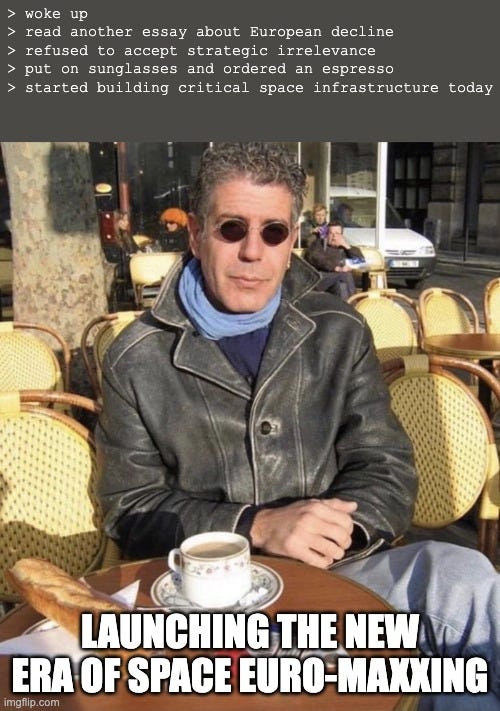
Europe has spent the last decade becoming very good at describing its own demise. We sit together inside a kind of decline panopticon (rigorously without AC), repeating that we are too slow, too fragmented, too regulated, too dependent, too late to AI, too late to scale. Some of that criticism is well deserved. Europe did miss major technological waves. We built strong rules for technologies we did not build. We became better at regulating platforms than creating them. We allowed too many critical layers of modern power, cloud, chips, AI infrastructure, launch, to be shaped and scaled elsewhere.
But the story of European technological decline is not the full story. There are still domains where Europe has the industrial depth and the geopolitical need to lead. Space is one of them. And maybe more than that: space can become the flagship of Europe’s return to technological confidence. Not because it is easy. Not because Europe is already winning everywhere. It is not. We have had painful reminders of dependence, especially around launch. We are still slower than we should be, too fragmented in procurement, and too hesitant when it comes to turning technical excellence into strategic advantage.
Space is one of the few strategic domains where Europe does not need to start from scratch. We already know how to build complex systems, coordinate deep industrial supply chains and engineer for reliability and precision in the most hostile environments. Space can become the domain where Europe proves to itself that it is not condemned to technological dependence, because it already has the foundations of a strong industrial base: world-class space companies, large primes with decades of experience, deep scientific institutions and the industrial muscle to deliver complex systems at scale.
That industrial base is no longer just a legacy advantage. It is starting to produce new European champions. ICEYE, the Finnish SAR satellite company, was recently valued at about €10bn after a major round, making it one of the most valuable space scale-ups in the world. Airbus, Leonardo and Thales have agreed to combine their space businesses into a new European champion with about €6.5bn in annual revenue and 25,000 employees.

Since at least the 1990s Gulf War, space has become an infrastructural enabler of power projection. The war in Ukraine made this impossible to ignore, showing both how satellite communications, Earth observation, positioning, navigation and timing have become part of the battlefield and how they are themselves threatened by increasingly sophisticated counterspace capabilities (you can learn more about the nature of modern space warfare in a16z’s excellent explainer2). Space is not an abstract domain floating above geopolitics. It is part of how wars are seen, fought, supplied, coordinated and understood. NATO now recognises space as an operational domain alongside air, land, maritime and cyberspace because communications, navigation, intelligence, surveillance and reconnaissance all depend on it.
While building Ecosmic, I have seen this first-hand. Our work today focuses on persistent awareness of the space domain: giving space commands a clearer picture of what is happening around critical space infra and helping them identify and pre-empt threats before they materialise. Over the past nine months, I have spoken with multiple European ministries of defence about the same question: how Europe can protect the space systems upon which its security increasingly depends. In a recent analysis, Ecosmic’s SDA platform Valkyr identified a series of close approaches in geostationary orbit involving Russia’s Luch/Olymp-2 and a western telecommunications satellite. The significance is not simply that one satellite came close to another. It is that these manoeuvres fit a broader pattern of suspicious activity around western assets: satellites that carry military, government and commercial weight, and that Europe cannot afford to lose sight of. The fact that these systems are now treated as potential targets is itself proof of their importance. They are vulnerable because they are critical.

So the question is simple: does Europe want to be a user of other people’s critical space infrastructure, or a builder of its own?
That distinction matters. A Europe that depends on others for launch, positioning, connectivity, Earth observation, and space domain awareness is not strategically autonomous. A Europe that builds those layers is a very different place. It is a Europe that can see for itself. Communicate securely for itself. Monitor its seas, forests, infrastructure, and adversaries for itself. Protect its satellites. Understand what is happening above it before it becomes a crisis.
This is why space can restore more than capability. It can restore technological confidence and hope for autonomy.
For too long, European technological ambition has been trapped between nostalgia and fear: nostalgia for the industrial successes of the past and fear that the future will be built elsewhere.
Space offers a way out of that psychology. It gives Europe a domain where its old strengths still matter, but where the next chapter has not yet been fully written. It carries both charisma and gravitas: space forces seriousness while still being deeply fascinating. That is the dream and the challenge Europe needs: something technically hard, politically meaningful, and with a high level of urgency that requires execution at accelerated speed.
The missing ingredient is cohesive will and a real push toward scale. Europe needs scale and shared imagination. Too many European space capabilities remain trapped between national programmes, fragmented demand, long procurement cycles, and institutional mechanisms too focused on requirements, and not real capabilities. If Europe wants technological confidence, it needs to create the conditions for its space companies to scale: through major continent-wide projects, starting with stronger support for IRIS² and Space Shield and a massive inflow of public and private capital to support the scaling phase.
But this also requires thinking collectively: the stack for European space leadership will never be built by one nation state alone, yet every country can make a decisive contribution if we lead with less fragmentation and more strategic coordination. We need to build where it matters for Europe, identify the fil rouge connecting the pieces we already own across different countries, and transform it into a strategy capable of seizing the momentum.
Europe is not as far behind as it sometimes tells itself. A technologically stronger Europe will not be built by invoking past industrial greatness, but by choosing the next strategic domains where leadership is still within reach, and acting with the conviction to win.
The question is no longer whether Europe can build. It is whether Europe still believes it should lead.